
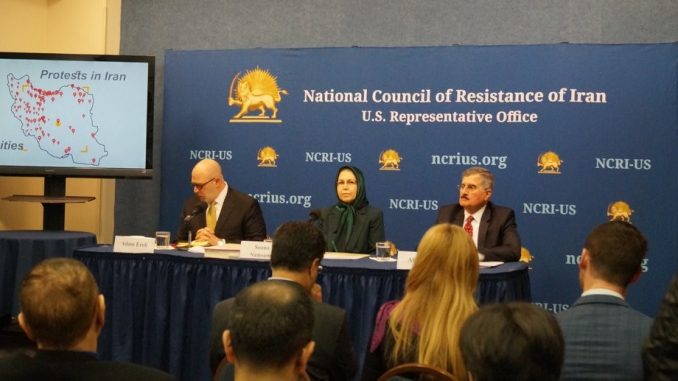

On Monday, February 11, the U.S. Representative Office of the National Council of Resistance of Iran (NCRI-US) sponsored a panel at Washington’s National Press Club to discuss the Iranian regime’s long and brutal domestic record at home and foreign policy abroad.
“While the Iranian regime on the 40th Anniversary of its rise to power attempts to display itself in a position of strength, in reality it is at its weakest point in history,” according to Soona Samsami, Representative for the NCRI-US.
The NCRI, the Iranian regime’s main opposition, believes that 40 years after the fall of monarchic dictatorship the prospects of change are shining brighter than ever before. Samsami examined the current situation, including major crises that the regime is facing, and expressed optimism about prospects for democratic change in Iran.
“The Iranian people are calling for the establishment of a republic based on democracy and separation of religion and state,” Samsami said.
“Contrary to the regime’s attempts to paint a picture of strength on its 40th year in power, in reality, it is at its weakest point in history,” she added.
Corruption, embezzlement by officials, poverty-stricken Iranians, the national currency’s spiraling value, and the unprecedented decline in citizens’ purchasing power were some of the indicators she cited of a failing theocracy.
On February 11, 1979, “the Iranian people toppled the Shah’s dictatorship known for his notorious secret police, SAVAK, the infamous Evin prison, and the lavish spending of his corrupt regime,” according to Samsami.
“Shortly after, however, Ruhollah Khomeini denied the Iranian people the democratic and representative government that they so desperately sought, and imposed a religious dictatorship.”
A video compilation of scenes was shown to the panel demonstrating the massive protests in 2018 and 2019, which encompassed more than 160 cities and towns in all of 31 provinces of Iran.
Former State Department official and ambassador to Bahrain, Adam Ereli , stated, ”Looking back on forty years of revolution: Yes, the mullahs are still there, but so is the MEK,” said the ambassador, referring to the main opposition Mujahedin-e Khalq (MEK).
He added that the fact that the regime’s senior officials, including Supreme Leader Khamenei, IRGC commanders, and Iranian President Rouhani, continue to slander the MEK “validates and substantiates the impact that this organization has had and continues to have.” Ereli said, “From the American side, I would simply argue that you’ve got a very capable opposition,” and, “the best thing the U.S. can do is to just stop appeasing the current regime.”
Ali Safavi of the NCRI’s Foreign Affairs Committee described “the ineffectual Western policy” over the past four decades, saying, “Everything [in the West’s policy] begins with the regime and ends with it. Lost in this approach have been the Iranian people.”
Western outlook amounted to a “policy of appeasement” that has actually “helped prolong the mullahs’ rule,” Safavi said.
“The right policy is to recognize the rights of the Iranian people and the organized opposition to overthrow this regime. Unlike Syria and other countries suffering from dictatorships, Iran has a historic, real and viable alternative,” he added.
On at least four occasions in 2018, Khamenei personally and publicly named the MEK for organizing large-scale protests. Rouhani has also blamed the MEK for organizing public protests. He also appealed to the French president to curtail their activities in Paris.
The regime has launched an extensive propaganda campaign against the MEK. Movies, drama series, and documentaries have been produced by the state to demonize the MEK’s image. “In 2018 alone, 18 major books were published by the regime against the MEK, bringing the total over the past few years to 519,” said Samsami.
The NCRI, formed in Tehran in 1981, can be described as a parliament-in-exile. It boasts hundreds of democracy advocates as members, half of whom are women, including athletes, politicians, musicians, economists and well-known personalities. The MEK is part of the broader coalition of NCRI.
“The NCRI’s President-elect, Maryam Rajavi, represents the demands and aspirations of the Iranian people and protestors in recent years. Units of Resistance posted her pictures in major highways and street corners.” Samsami explains.
“Mrs. Rajavi’s 10-point plan for Iran’s future includes policy formulations like: separation of church and state; abolition of the death penalty; universal suffrage and elections; gender equality; peace and co-existence with neighbors; and freedom of the press and speech.” She adds.
According to Samsami, “Recognition of the NCRI as the sole democratic alternative to the terrorist regime and religious dictatorship in Iran is the imperative to rectify and end the disastrous policy of appeasement over the past four decades.”
(Source: INU)